China Top Trampoline Games for Kids Beyond Jumping

Time:2026-09-14 Author:Isabella
0%

A trampoline can be more than a platform for repeated jumps. It can become a small movement laboratory, where children practice balance, timing, memory, and cooperation. This matters in China, where the National Fitness Plan (2021–2025) targets regular exercise for 38.5% of the population by 2025. Children need enjoyable activities that support this wider fitness culture.

The World Health Organization recommends at least 60 minutes of moderate-to-vigorous physical activity daily for children and adolescents. Trampoline games can contribute when adults control intensity, space, and duration. So, what are some trampoline games for kids that aren't just jumping? Options include target toss, freeze-and-balance, color-corner races, memory commands, and gentle balloon control. A child might land, touch a blue marker, and hold still for three seconds. Another child might follow a sequence such as clap, turn, and squat. These simple challenges build listening skills and body awareness.

Safety remains essential. The American Academy of Pediatrics advises against recreational trampoline use at home and stresses supervision, one jumper, and suitable protective practices in structured settings. Games should never reward risky flips or crowded play. A trained instructor should inspect equipment and explain clear boundaries. Not every game fits every child. Some children may feel dizzy, anxious, or overstimulated. That limitation matters. A responsible program adjusts the rules, lowers the pace, and offers a nearby floor-based alternative. The best Chinese trampoline activities are not the loudest ones. They are measurable, inclusive, and carefully designed for real children.
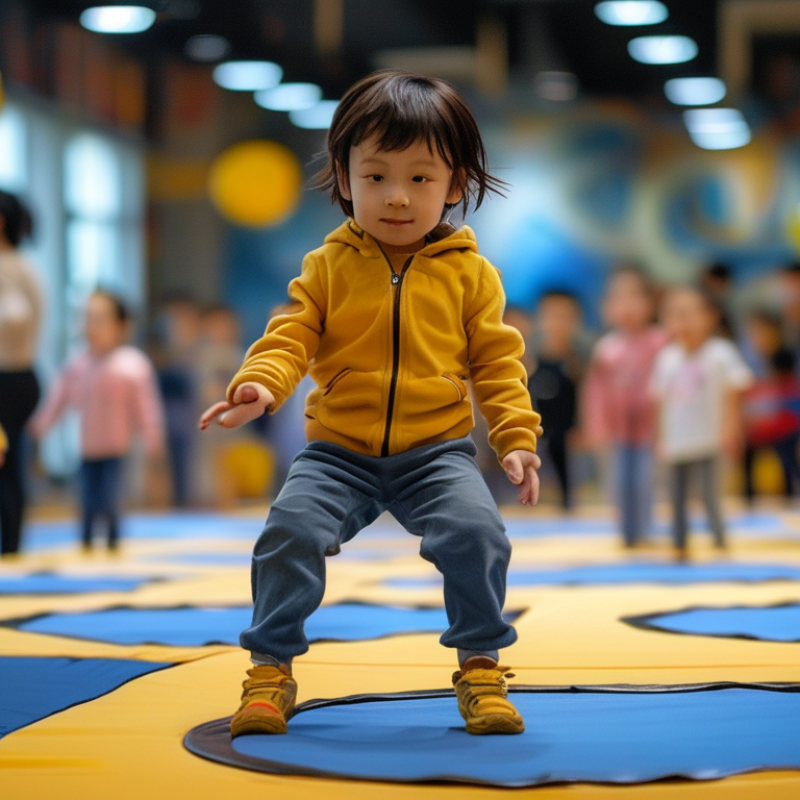
China Top Trampoline Games for Kids Beyond Jumping

What Makes Trampoline Games Popular Among Children in China

In China, trampoline games appeal because they turn simple jumping into shared play. Children can race across soft platforms, copy movement patterns, or collect foam blocks. The activity feels energetic without demanding advanced sports skills. A five-year-old can join a seven-year-old with adjusted rules. Indoor venues also offer a practical option during hot summers, rainy days, and poor-air-quality periods. Families value that flexibility.

The social element matters. Children call out scores, wait for turns, and invent challenges together. These small interactions build communication and body awareness. Coaches usually recommend short rounds, clear boundaries, and adult supervision. Grip socks, safe landing zones, and space between players reduce common risks. Parents can watch whether a child looks tired, dizzy, or unusually quiet. Rest is part of the game, not a failure.

Beyond jumping, popular games include follow-the-leader, target landing, balance walks, and gentle team relays. They give children a reason to repeat basic movements. Repetition can improve confidence, although progress is not always smooth. Some children dislike competition or feel nervous on higher platforms. A quiet role, such as timekeeper, may help them join later. Adults sometimes add too many rules. The playground becomes less playful. Simple choices often work better.

China Top Trampoline Games for Kids Beyond Jumping

What Makes Trampoline Games Popular Among Children in China?

Trampoline games combine active movement with simple rules, social interaction and achievable challenges. The chart uses an evidence-informed 1–5 engagement index based on widely recognized child-development factors: physical activity, coordination, balance, cooperation and novelty. It is a comparative index rather than a commercial market survey.

Reference context: World Health Organization, Guidelines on Physical Activity, Sedentary Behaviour and Sleep for Children and Adolescents.

Types of Trampoline Games That Go Beyond Simple Jumping

China Top Trampoline Games for Kids Beyond Jumping

Beyond Simple Jumping

Trampoline play can become a small indoor adventure, not just repeated bouncing. Children can try “color call,” touching a named floor marker after each controlled landing. “Freeze bounce” adds listening skills, while balloon keep-up develops timing and gentle hand control. A target-toss game works well with soft fabric balls and marked zones. It encourages aiming without turning the trampoline into a race.

A simple obstacle route can include crawling, sitting, balancing, and stepping off carefully. These movements challenge coordination in different ways. The American Academy of Pediatrics reported more than 100,000 trampoline-related injuries annually in the United States, with fractures among common outcomes. The U.S. Consumer Product Safety Commission’s NEISS surveillance also identifies falls and collisions as recurring injury mechanisms. These figures should change how adults design games. More excitement is not always better.

Tips: Keep one child on the surface. Remove hard objects and loose toys. Use a clear stop signal. Choose games that reward control, not height. An adult should watch continuously, especially with younger children. Stop play when a child looks tired or loses balance. This part is easy to neglect. It should not be. Coaches can also ask children which game felt difficult, then adjust the rules instead of simply adding speed.

Safety Rules and Equipment for Children’s Trampoline Activities

Trampoline games can offer more than repeated jumping. Children can play “freeze on landing,” follow color commands, or copy a coach’s gentle knee lifts. These activities build balance, listening, and body control. Keep every game low, simple, and suitable for the child’s age.

A responsible adult should supervise every session from nearby. Only one child should use the trampoline at a time. Check the enclosure, frame, springs, and jumping mat before play. The safety net must be secure, and the padding should cover hard edges completely. Follow the equipment’s age and weight limits carefully. No flips, wrestling, pushing, or climbing on the net. Stop immediately during rain, strong wind, or slippery conditions.

Bare feet or suitable non-slip socks can improve control. Remove loose jewelry, scarves, and sharp objects. Children should enter with a stable ladder and wait outside until the surface is clear. A short warm-up helps, even if children seem eager. I have seen excited players ignore simple rules after a few minutes, so reminders should be calm and frequent. Adults should also watch for tired landings, dizziness, or sudden silence. Stop play when technique becomes careless. Some families may feel strict rules reduce fun, but predictable boundaries often make children feel safer. A first-aid kit and emergency contact details should remain close to the activity area.

How to Choose Age-Appropriate Trampoline Games

China Top Trampoline Games for Kids Beyond Jumping

Choosing a trampoline game should begin with age, coordination, and supervision. Children aged three to five need simple games, such as “freeze” or touching colored markers. Keep both feet together. Sessions should last only a few minutes.

Children aged six to eight can try controlled turns, balance poses, and soft target games. Older children may practice planned sequences, but advanced flips require qualified instruction.

The U.S. Consumer Product Safety Commission’s NEISS analysis estimated about 100,000 emergency-department-treated trampoline injuries annually from 2002 to 2011. The American Academy of Pediatrics advises against home trampoline use and stresses careful supervision in organized settings. These findings make age matching more than a teaching preference. It is a safety decision.

Use one child at a time, with clear boundaries and an adult watching continuously. Remove hard objects from nearby areas. Stop the game when a child looks tired, distracted, or fearful.

A practical coaching rule is simple: choose control before height. This rule is not perfect. A confident seven-year-old may still lack safe landing skills. A cautious nine-year-old may need an easier activity.

Watch the child, not only the birth date. Short instructions work best: “wait,” “land softly,” and “freeze.” Development varies, and I would rather repeat a basic game than rush a difficult one.

Skills Children Can Develop Through Trampoline Games

China Top Trampoline Games for Kids Beyond Jumping

Trampoline games can build more than leg strength. In supervised sessions, children learn balance by holding still after a gentle bounce. They also practise body control when landing inside a marked center zone. A “freeze” game adds focus. The child bounces softly, then stops when an adult calls a signal. This simple pause can strengthen listening skills and self-regulation.

Some games develop coordination and spatial awareness. Children can copy a partner’s safe arm movements or follow a slow rhythm of claps. They may count jumps, change direction carefully, or remember a short movement pattern. These tasks encourage memory and problem-solving. Small successes often improve confidence. Quiet children may also communicate more when they choose the next simple movement.

Keep the activities age-appropriate and calm. One child should use the trampoline at a time, with a trained adult nearby. Check the equipment, follow its safety guidance, and avoid flips or competitive pushing. Not every child enjoys the same challenge. That matters. A game that seems easy for one child may feel overwhelming to another. I have found that shorter rounds work better, although this approach is not perfect. Children sometimes need to stop, watch, and try again. Their progress may look uneven, but careful practice still builds useful skills.

FAQS

What games go beyond simple bouncing?

Try color call, freeze bounce, balloon keep-up, and soft target toss.

How does color call work?

Place soft, colored markers around the center area.

Is balloon keep-up suitable for young children?

It can suit younger children when an adult watches closely.

What simple games support balance and listening?

Freeze bounce asks children to stop when they hear a signal.

How should games match a child’s age?

Children aged three to five can touch markers or play freeze.

What skills can trampoline games develop?

Supervised games can practise balance, coordination, timing, memory, and body control.

What safety rules should adults follow?

Allow one child on the surface at a time.

When should a trampoline game stop?

Stop when a child looks tired, distracted, fearful, or unsteady.

Should games reward height or control?

Reward soft landings, careful movement, and waiting for instructions.

Conclusion

Trampoline games are popular among children in China because they combine exercise, excitement, creativity, and social interaction. What are some trampoline games for kids that aren't just jumping? Children can enjoy activities such as balance challenges, soft-ball toss games, target landing, follow-the-leader movements, obstacle courses, and simple timed routines. These games make trampoline play more varied while encouraging cooperation, coordination, and imaginative movement.

Safety should always come first. Children need suitable padding, secure equipment, clear space, adult supervision, and rules such as taking turns, avoiding rough play, and stopping when tired. Games should match a child’s age, confidence, physical ability, and understanding of instructions. Younger children may benefit from basic balance and guided movement games, while older children can try more complex routines and obstacle challenges under supervision. Through regular participation, children can develop balance, flexibility, timing, strength, body control, concentration, confidence, and communication skills in a safe and enjoyable environment.

Isabella

Isabella

Isabella is a dedicated marketing professional with a sharp focus on driving brand growth and engagement through strategic content creation. With an extensive background in digital marketing, she combines her passion for storytelling with her keen understanding of industry trends to deliver......